
Peptides
 IGF 1 LR3 vs DES: Which Peptide Is Best for Muscle Growth and Research?
Disclaimer: Products sold by Wholesale Peptide, is intended as a research chemical only. This designation allows the use of This chemical strictly for In-vitro laboratory testing and experimentation. No other uses or purposes are permitted. All information provided on this website is for educational purposes and has been compiled from multiple sources believed to be accurate. Human or animal use of this product is strictly forbidden by law. This product is not a drug, food or cosmetic and may not be misbranded, mislabeled or misused as such. Anyone not adhering to these terms will be blacklisted and forbidden from purchasing.
This article breaks down their differences to help you choose the right one for your research needs.
Key Takeaways
-
Quality assurance is critical when sourcing IGF-1 LR3 and IGF-1 DES for research, with purity testing and reputable suppliers ensuring valid study results.
Understanding Insulin Like Growth Factor Variants
IGF-1 has several variants resulting from single amino acid changes, which can significantly affect their functionality. However, it’s important to note that elevated IGF-1 levels have been linked to an increased breast cancer risk, highlighting the need for careful consideration in research applications.
What is IGF-1?
Dietary factors, such as higher protein intake, can increase IGF-1 levels, while reducing protein intake may lower them. Supplements and other dietary influences can also affect IGF-1 levels.
Most of the IGF-1 in the body is produced in the liver, and abnormal levels can lead to various health issues, including the growth of unhealthy cells. This makes the regulation of IGF-1 crucial for maintaining balanced growth and development in research settings.
Definition and Function of IGF-1
Produced primarily in the liver, IGF-1 levels peak around puberty, a critical period for human growth. Maintaining proper IGF-1 levels is essential for optimal health, as imbalances can lead to a range of health issues, from growth deficiencies to the proliferation of unhealthy cells.
Differences Between IGF-1 LR3 and IGF-1 DES
IGF-1 LR3 and IGF-1 DES are two prominent variants of IGF-1, each with distinct structural and functional characteristics. IGF-1 LR3 has a longer peptide chain, enhancing its structural stability compared to IGF-1 DES, which has a shorter sequence.
The longer half-life of IGF-1 LR3, which allows for prolonged activity in the body, contrasts with IGF-1 DES’s design for rapid action due to its short half-life.
Mechanisms of Action
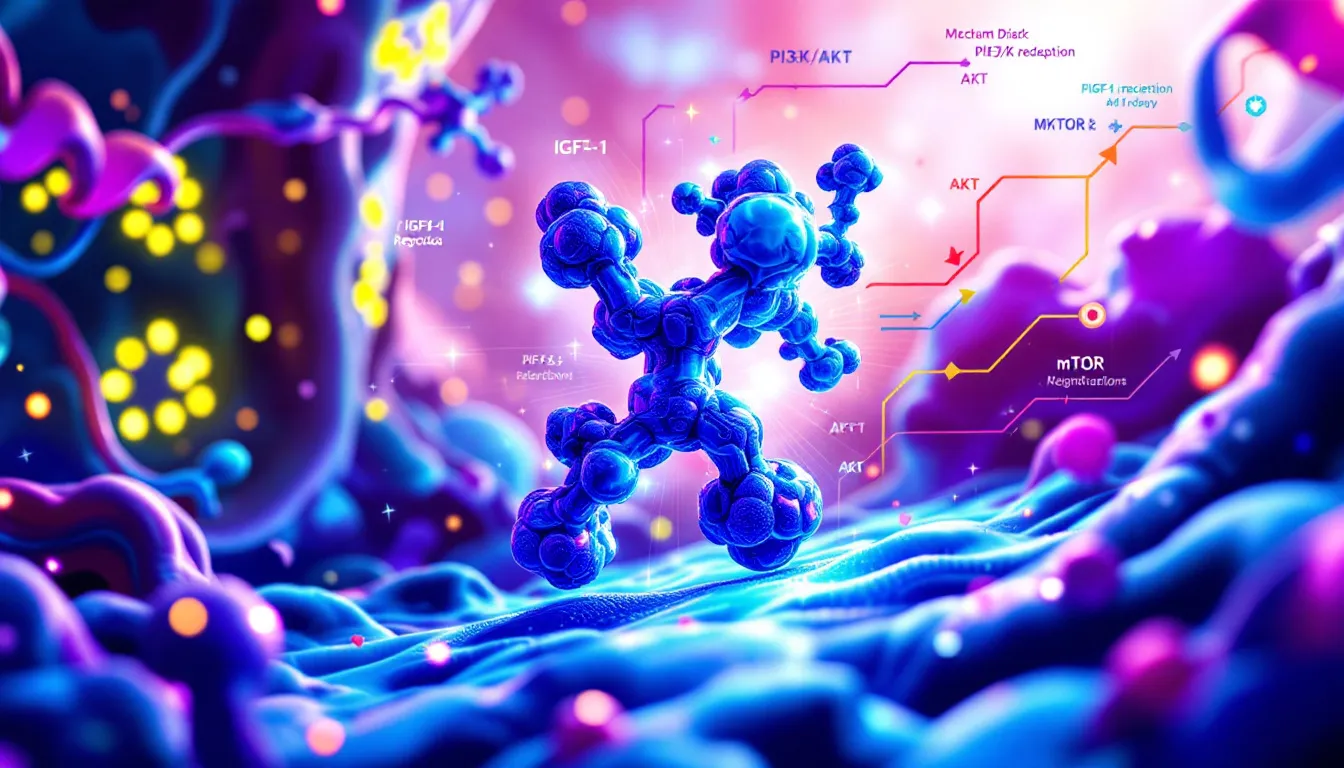
IGF-1 LR3: Extended Half-Life
IGF-1 DES: Rapid Action
IGF-1 DES, on the other hand, is designed for rapid action with a very short half-life of about 20-30 minutes.
Binding to IGF-1 Receptors
IGF-1 exerts its effects by binding to the IGF-1 receptor (IGF-1R), a complex structure composed of two alpha and two beta subunits linked by disulfide bonds. The transmembrane beta subunits of IGF-1R contain intracellular tyrosine kinase domains, which are activated when IGF-1 binds to the extracellular alpha subunits.
Upon activation, these kinase domains trigger multiple signaling pathways, including the PI3K/Akt pathway and the Raf/MEK/ERK cascade.
While IGF-1 primarily acts as an endocrine hormone secreted by the liver and transported to target tissues, it is also produced locally in various tissues. In these contexts, IGF-1 acts in a paracrine fashion, affecting nearby cells, and plays an important autocrine role, particularly in cancer, where it can influence tumor growth and progression.
However, it’s also important to consider the potential side effects associated with IGF-1 LR3, such as insulin resistance. Research suggests that it’s important to consider the potential breast cancer risk associated with elevated IGF-1 levels, which underscores the need for careful monitoring in research applications.
These properties make IGF-1 LR3 and IGF-1 DES valuable tools in research focused on providing different benefits based on their unique
This makes it a valuable compound in studies focusing on and body composition management.
IGF-1 LR3 Side Effects and Increased Cancer Risk
Studies indicate that IGF-1 LR3 could lead to insulin resistance in research settings. This is an important consideration, highlighting the need for thorough understanding and cautious application. Additionally, elevated IGF-1 levels have been linked to an increased breast cancer risk, which is an important consideration in research contexts.
Serious Risks and Contraindications
Reports have suggested adverse effects such as swelling, headaches, and an increased cancer risk. Due to these significant risks, IGF-1 compounds are generally recommended for research use only.
This is because IGF-1 may inhibit apoptosis, or programmed cell death, which can facilitate the spread of cancerous cells.
Understanding these risks is crucial for researchers, emphasizing the importance of cautious and informed use.
Applications in Research
The potential applications of IGF-1 LR3 and IGF-1 DES in research are vast.
Recombinant IGF-1 was developed in the late 1980s. As organisms age, the production of IGF-1 decreases, which may influence various health aspects.
High levels of IGF-1 can complicate cancer treatment by potentially making it more difficult to address the disease. Research suggests that understanding these dynamics is crucial for developing effective study strategies. High levels of IGF-1 have been linked to an increased breast cancer risk, which is an important consideration in
Purchasing IGF-1 LR3 and IGF-1 DES

For researchers looking to explore the potential sourcing high-quality compounds is crucial. These variants are primarily available through online vendors specializing in research peptides. Research-grade IGF-1 LR3 and IGF-1 DES can be sourced from specialized suppliers focusing on biotechnology products.
Ensuring that these compounds are purchased from reputable suppliers is essential for maintaining the integrity of research studies.
Quality Assurance
Quality assurance is critical when purchasing research compounds like IGF-1 LR3. Purity levels are often assessed through techniques such as SDS-PAGE and HPLC, ensuring high quality.
Third-party verification adds an additional layer of trust, confirming the claims made by manufacturers regarding the purity and quality of IGF-1 LR3 products.
Ordering Information
We offer free shipping on orders exceeding $99. It’s important to note that all products sold by us are for laboratory research purposes only.
Ensuring proper sourcing and understanding the terms of purchase can help researchers obtain the necessary materials for their studies efficiently and with confidence.
Summary
Summarize the key points discussed in the blog post, emphasizing the importance of IGF-1 variants in research.
Frequently Asked Questions
What is the difference between IGF-1 and IGF-1 DES?
IGF-1 DES is a truncated version of IGF-1, missing the first three amino acids at the N-terminus, which gives it a very short half-life.
What is the difference between IGF-1 and IGF LR3?
IGF-1 LR3 is a modified version of IGF-1 with an extended half-life due to the addition of long arginine at the third position.
How does IGF-1 LR3 make you feel?
However, it’s important to note that individual reactions can vary, and potential side effects like insulin resistance should be monitored.
Is IGF-1 LR3 illegal?
IGF-1 LR3 is not approved for human use by many regulatory bodies due to potential health risks and is often restricted to research purposes. It is important to verify the legal status of IGF-1 LR3 in your region before considering its use.
What does IGF DES do?
References and Citations
-
Clemmons, D. R. (2009).
-
Jones, J. I., & Clemmons, D. R. (1995). “Insulin-like growth factors and their binding proteins: biological actions.” Endocrine Reviews, 16(1), 3-34. doi:10.1210/edrv-16-1-3.
-
Yu, H., & Rohan, T. (2000). “Role of the insulin-like growth factor family in cancer development and progression.” Journal of the National Cancer Institute, 92(18), 1472-1489. doi:10.1093/jnci/92.18.1472.
-
Laron, Z. (2001).
-
Pollak, M. (2008). “Insulin and insulin-like growth factor signalling in neoplasia.” Nature Reviews Cancer, 8(12), 915-928. doi:10.1038/nrc2536.
-
LeRoith, D., & Roberts, C. T. (2003). “The insulin-like growth factor system and cancer.” Cancer Letters, 195(2), 127-137. doi:10.1016/S0304-3835(03)00159-9.
-
Florini, J. R., Ewton, D. Z., & Coolican, S. A. (1996).

